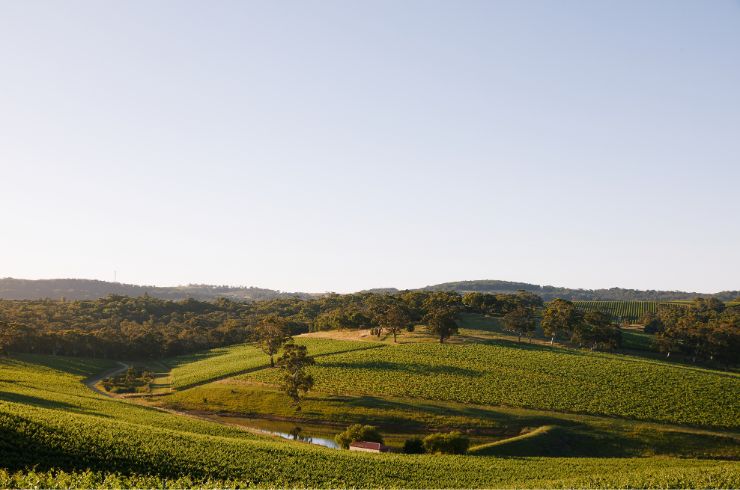
“When I worked in McLaren Vale, everyone spoke about the Adelaide Hills as this beautiful, almost mythical place,” says Brendon Keys, who established BK Wines in Basket Range in 2007. “The attraction was its looseness; unlike other regions, there were no preconceived styles or ideas.”
Basket Range is a secluded hamlet in the Adelaide Hills, home to forested hills, spring-fed gullies and rich, red clay soils. It’s also the epicentre of Australia’s natural winemaking scene, with names like Anton Van Klopper (Lucy Margaux), Gareth Belton (Gentle Folk), Jasper Button (Commune of Buttons) and the late Taras Ochota (Ochota Barrels) establishing themselves here in the 2000s and 2010s. At its peak, and despite the Hills’ burgeoning reputation for premium sparkling, chardonnay and pinot noir, the movement was so influential that many associated these lo-fi, energetic and living wines with the broader region.
For others, the Adelaide Hills’ prevailing style has always been the clean, crisp expressions pioneered by Brian Croser’s Petaluma, who sparked the region’s revival when he established the Tiers vineyard in the Piccadilly Valley in 1978. Armed with what he’d learned about terroir-driven planting from California’s UC Davis, Brian determined that, as the highest, coolest, and wettest area in the Hills, chardonnay, pinot noir and other cool-climate varieties would thrive here. With high-profile producers including Stephen George (Ashton Hill), Prue and Stephen Henschke, Tim Knappstein (Riposte) and Geoff Weaver planting their own vineyards in the Piccadilly Valley and nearby Lenswood not long after, it was quickly cemented as the region’s core.
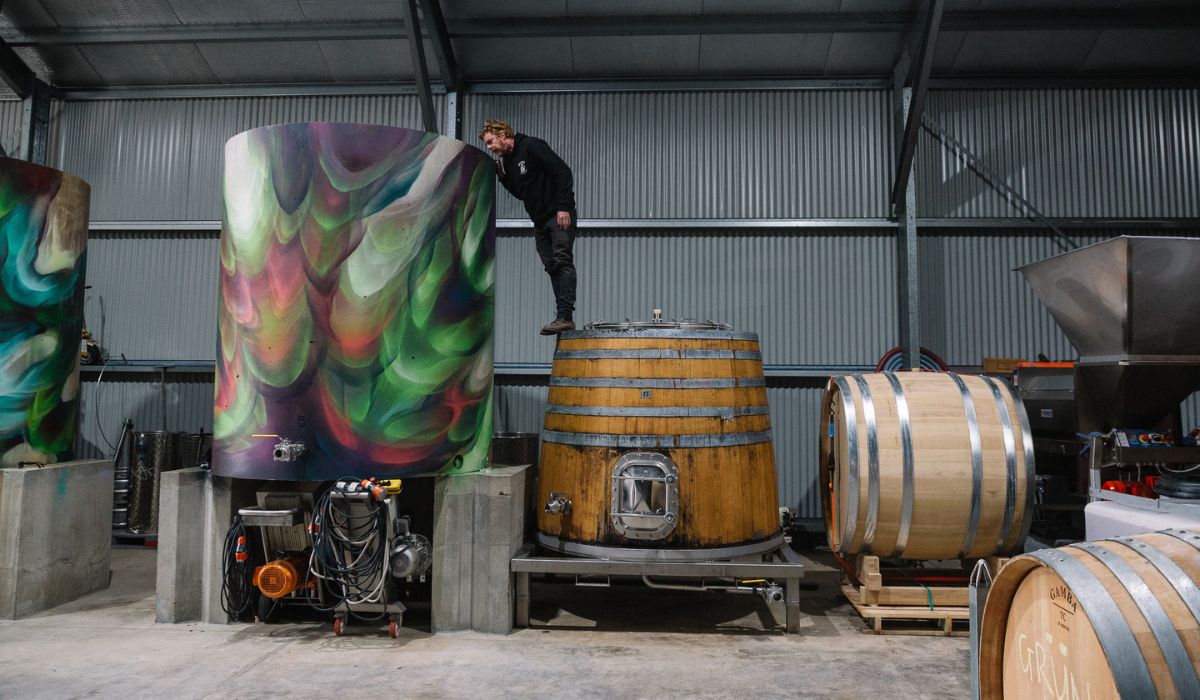
Although I’d been to the Adelaide Hills several times over the years, it wasn’t until my most recent trip, where I spent three full days visiting the wineries and vineyards of eight different producers (and driving past many more), that I began to grasp its complexities. Located east of Adelaide and stretching from McLaren Vale in the southwest all the way to the Barossa and Eden Valleys in the north, it’s a deceptively large region geographically (although not in volume, at around 2 per cent of the national grape crush). It’s also very diverse, with an ancient geology that has given rise to drastic variances in climate, altitude (up to 700m), topography (ranging from steep slopes to undulating hills) and soil types, with everything from clay to sandy loams to shale and ironstone, in varying depths, structures and chemistries.
Because there is such a broad range of growing conditions, a lot of different grape varieties (and clones – Sidewood Estate is the only producer I know of who bottles a pinot noir made solely from the Oberlin clone) can be successfully cultivated within the Adelaide Hills. While this is unequivocally a good thing, it complicates the marketing. Take sauvignon blanc. Although it’s the most planted variety in the region today, representing a quarter of all varieties under vine, there’s not the same recognition among consumers for ‘Adelaide Hills sauvignon blanc’ (outside of Shaw + Smith’s benchmark expression) as there is for ‘Barossa shiraz’ or ‘Yarra Valley chardonnay’.
Instead, the region is becoming almost as well-known for alternative varieties, such as grüner veltliner (there’s even a local ‘Grüner Growers Group’), nebbiolo and barbera (which Longview Vineyard is having enormous success with, in particular), sangiovese (La Prova and Gentle Folk’s expressions are easily among Australia’s finest), and gamay,
which is finding a home among all the pinot noir and chardonnay planted in Piccadilly and Lenswood. In fact, a gamay – the World’s Apart 2025 Blue Eyes – took home the trophy for Best Red Wine at last year’s Adelaide Hills Wine Show.
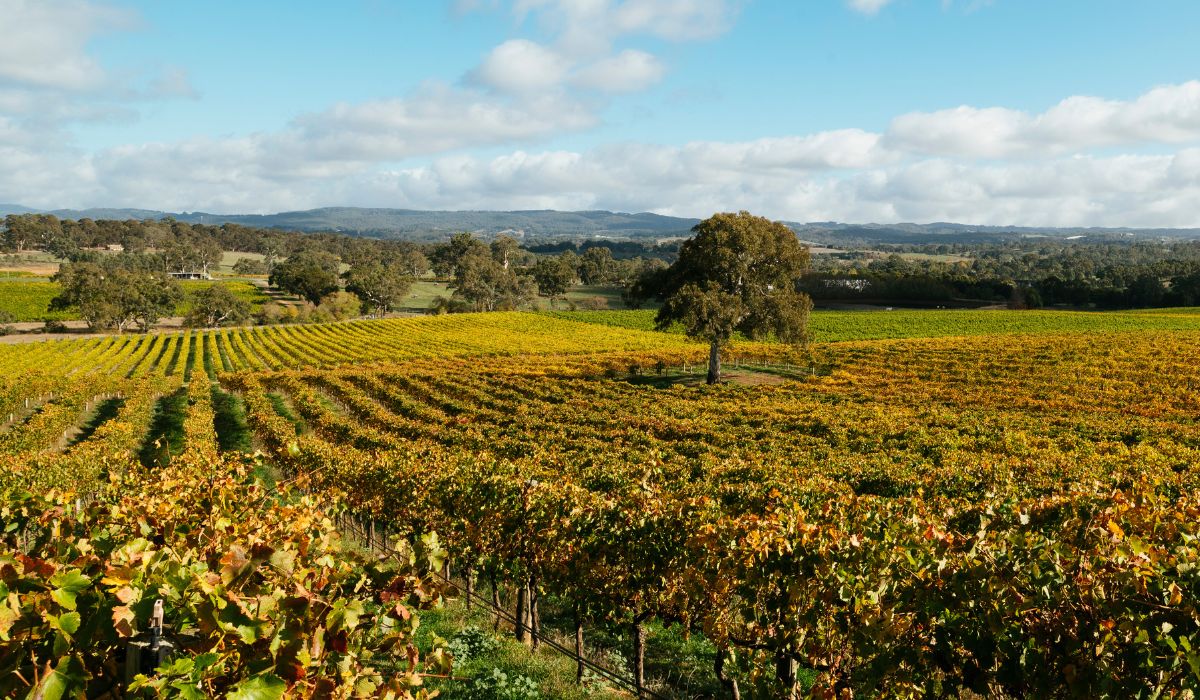
Some producers believe focusing on and championing subregionality would help make sense of the broader region. “The fact that the Adelaide Hills only has two official subregions is a bit of a tragedy,” says Brian Croser, who was heavily involved in the registration of Lenswood in 1998 and Piccadilly Valley in 2000 as GIs. “There is room for at least another half-dozen subregions, which would help people identify what the Hills are all about.”
It’s a valid argument. If there is a combination gaining cut-through with consumers, Lenswood chardonnay or Piccadilly pinot noir would be it. But despite eight additional subregions being identified in a report conducted by Davidson Viticulture more than 20 years ago – Paracombe, Charleston, Echunga, Mount Barker, Birdwood, Hahndorf, Macclesfield and Kuitpo – and arguments for the demarcation of more today, there hasn’t been a concerted push (at least according to the regional body) to formalise them. This is partly politics – determining precisely where boundary lines lie is fraught. And, even within single sites, growing conditions aren’t always analogous.
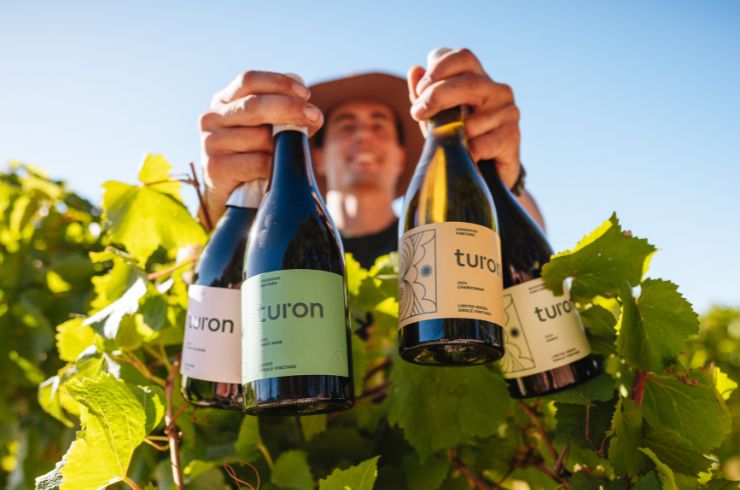
“It’s a conversation the region is constantly having,” says Turon White of Lenswood-based Turon Wines. “There are so many considerations. Differences in ripening times, humidity, soil types… the Onkaparinga Valley is quite a large area but, because it’s a basin, conditions are pretty consistent, whereas even though Lenswood and Basket Range are geographically close, they’re so different,” he adds.
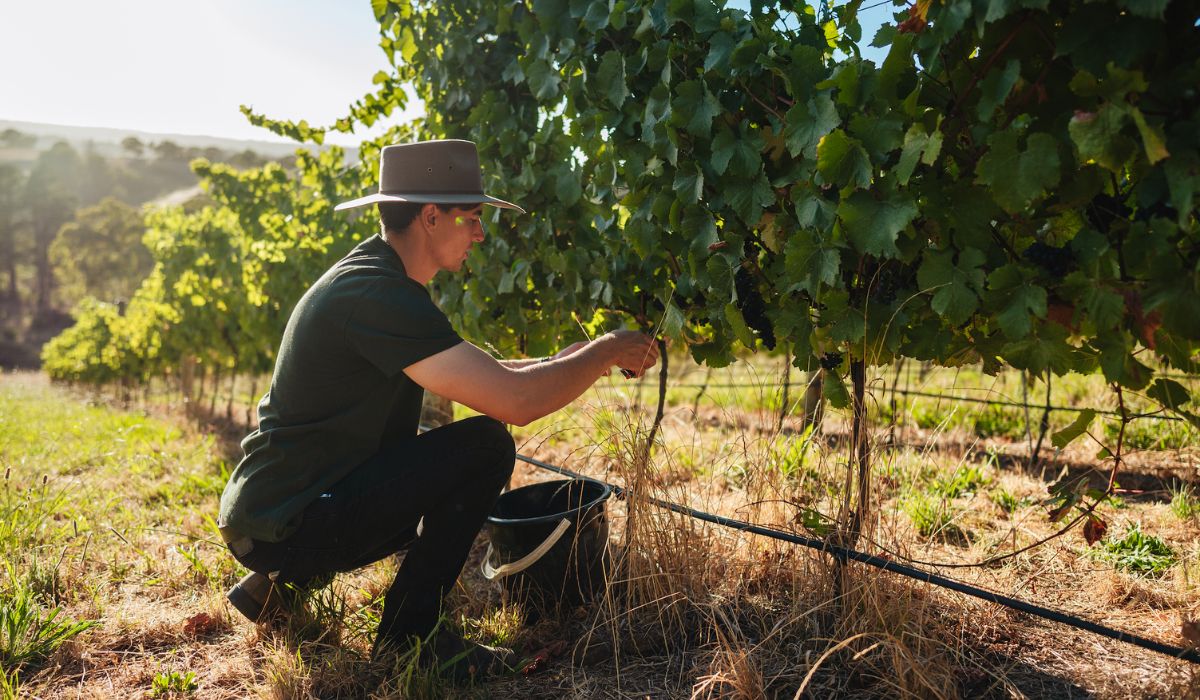
“It has to make sense from a viticultural perspective because you’re identifying distinct viticultural regions, but it also needs to be fair. There has to be the consensus of the region as a whole, who need to say ‘yes, that’s correct, we’re happy with that.’”
There are also criteria that need to be met for a GI to be formalised. According to Wine Australia’s Geographical Indications Committee, to be eligible for determination as a GI, a grape-growing area must usually produce at least 500 tonnes of grapes per year, include at least five wine grape vineyards of at least five hectares each (that do not have common ownership), and be a single tract of land.
This rules out areas like Macclesfield, which ironically makes one of the strongest cases for distinction. Located near the region’s southern border, its semi-maritime, moderate climate has more in common with McLaren Vale’s than the central or northern areas of the Hills. “But needing five producers to be on board with the submission cuts us out, unfortunately,” says Peter Saturno, CEO of Longview Vineyard. “We don’t have enough in the area.”
The Adelaide Hills Wine Region body has a different take, however. “While it is extremely useful to have this diversity detailed into subregions for viticulture purposes,” says Sarah Carlson, executive officer of AHWR, “whether it is beneficial to have them officially registered as individual Geographical Indications is another matter.

“As the benefits are in marketing, and as it is quite a costly process, it is a cost-benefit consideration,” she says. She also makes the point that registering and promoting 10 different subregion GIs would dilute the AHWR’s ability to promote the region as a whole, both domestically and on a global stage.
“Amongst themselves, though, our growers and wine producers absolutely do refer to these important geographical distinctions – terroir matters hugely to premium grape and wine production, and our local subregional differences are well appreciated,” she adds. “If producers see value in adding localities such as ‘Kuitpo’ or ‘Hahndorf’ to their labels, they do so.”
“We almost have a village cru system,” Turon confirms. “Internally, we say that’s Macclesfield fruit, that’s Woodside fruit, that’s Lenswood fruit. That’s just the natural vernacular people have started using.”
So, if not by subregion, grape variety or wine style, how do we define the Adelaide Hills? And do we need to – does it matter?

“I think it’s a long game,” says Brendon Keys. “As (English wine writer) Andrew Jefford said when he visited the Adelaide Hills, it’s a bit like when the monks discovered Burgundy – it took a long time to work out what was what and where and why.
“I get wanting to understand the Hills,” he adds. “But getting people to visit is where education will come from. With our tasting room, we get to tell the story of our site. I think a lot of what we’re trying to do will happen just by people coming to visit, which is important.”
For me, the answer is simple: its diversity is what defines the Adelaide Hills. There are few regions on earth that can offer such a broad range of wine styles, and that such a varied and eclectic mix of makers call home. Rarer still is to find all this an Uber ride from the city.
“I honestly believe there’s no other region in Australia that could rival us when it comes to site selections, varietal choices, and clonal choices as well,” says Peter Saturno. “I’m really proud of the Adelaide Hills.”
This article first appeared in issue #82 of Halliday magazine. To receive the magazine, unlock digital access to over 185,000 tasting notes, and more, become a member now.
Sign up to view these tasting notes and ratings
By becoming a member of Wine Companion, you'll have access to the largest database of wines in Australia.
Subscribe to the Halliday Wine Companion Podcast
Hear from some of Australia's top winemakers and industry professionals as they share their stories and insights on the Halliday Wine Companion Podcast. Listen here, or on your usual podcast platform, and remember to rate, share and subscribe so you never miss an episode.
Latest Articles
-
![Default article tile image]()
From the tasting team
Marcus-Ellis-cabernet-cartel
19 hours ago -
News
The cost of silence: Mental health in the wine industry
2 days ago -
Wine Lists
Autumn has arrived, so here are 11 shiraz wines for you to try
7 May 2026 -
From the tasting team
Steadfast shiraz: Katrina Butler on the challenges facing Australian shiraz
7 May 2026